



Notre-Dame-de-Vie
The celebrities’ chapel
The chapel
Adjacent to the Mas Notre-Dame de Vie, the last residence of the Master Picasso, the Notre-Dame-de-Vie chapel is enthroned in the middle of an alley of tall Florentine cypresses in a serene Tuscan atmosphere. In the distance, perched on its peak, the silhouette of the old village of Mougins can be seen silhouetted against the sky…
This has been the case since the 12th century, when the chapel was built, rebuilt and slightly enlarged in 1654. Listed as a historical monument since 1927, its last renovation dates back to 2012, when the site was restored by the town of Mougins, thanks to the support of the DRAC PACA, the PACA Region, the Conseil Général 06 and numerous donors who took part in the public subscription with the Fondation du Patrimoine.
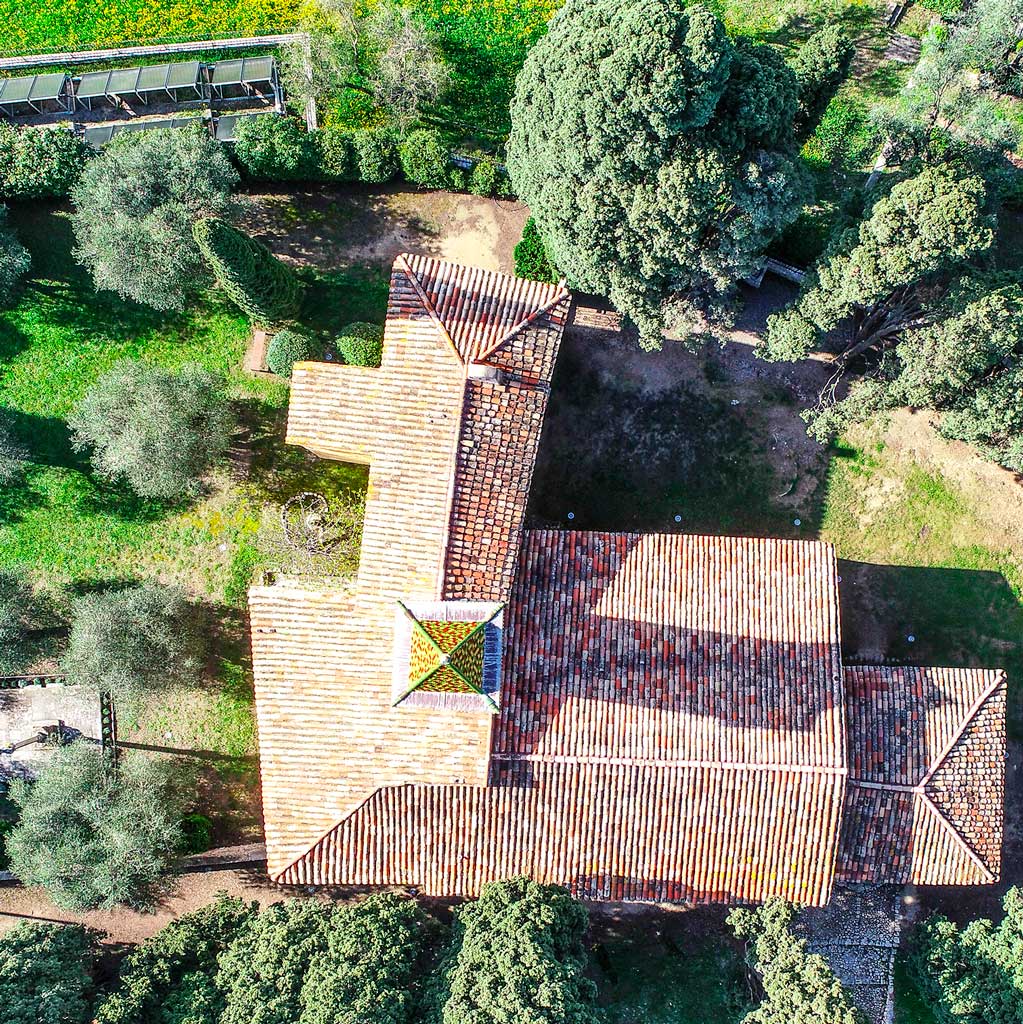
Based on a rectangular plan with a nave made up of a main nave and a secondary nave, the building catches the eye from the outside with its colonnaded porch decorated in ochre and sand colours. Inside, the walls are covered with ex-votos.
Of particular note is that of the Pénitents blancs, which depicts the exceptional pilgrimage of the Pénitents blancs from the Saint-Michel chapel in Grasse to Notre-Dame de Vie in 1755, when they made a vow.
In 2013, to mark the restoration and inauguration of the Notre-Dame-de-Vie chapel, Italian artist Lucio Oliveri dedicated and hung an 87cm bronze crucifix over the church’s altar.

A respite sanctuary
Until 1730, the site was a “respite” sanctuary where families from all over the region came to have stillborn babies baptized. The Guinness family, former owners of Mas Notre-Dame-De-Vie and the hermitage cemetery, had the remains of the little bodies transferred under a single slab, under the protection of a Virgin and Child, with the epitaph: ” Here lie innocent children who died at birth. R.I.P .
Until the 1970s, a procession took place between the village and the chapel, celebrating Sainte-Innocence, a virgin martyred in Rimini in 390 and patron Saint of Mougins.
From the Guinness family to Picasso
In 1961, Picasso, who had discovered Mougins in 1936, bought Mas Notre-Dame-de-Vie from the Guinness family as a wedding present for his future wife Jacqueline. Until the end of his life, this home located below the chapel was the stage for his prolific and final creation. He breathed his last on April 8, 1973.
But he wasn’t the only illustrious figure to appreciate the site. It is said of the chapel that ‘the whole world came to admire it’: from musicians Mstislav Rostropovitch and Arthur Rubinstein to Charlie Chaplin, Jean Cocteau and Winston Churchill.
The garden and the tomb
The retreat’s treasures
The hermitage would have been built around 1613. It now houses a museum space, ‘The Treasure of Notre-Dame-de-Vie’, which traces the unique history of the chapel. The 1st and 2nd floors feature a collection of photographs of Picasso taken at Notre-Dame-de-Vie by his friend and renowned photographer Lucien Clergue. Photographs on loan from the Mougins Museum of Classical Art.
+33 (0)4 92 92 14 00
Open all year depending on season:
- Every day in July and August from 10am to 1pm – 3pm to 7.30pm
- • Every weekend in May, June and September from 10:00 to 12:30 and 14:00 to 19:00
- Every Sunday, October to April, 10am to 1pm – 2pm to 5pm
Free admission
501-869 chemin de la Chapelle
Accessible to wheelchair users